
The flamingos of Lake Natron, and why the lake is red
Lake Natron is too salty and too hot for almost anything to live in. That is exactly why East Africa's lesser flamingos choose it.
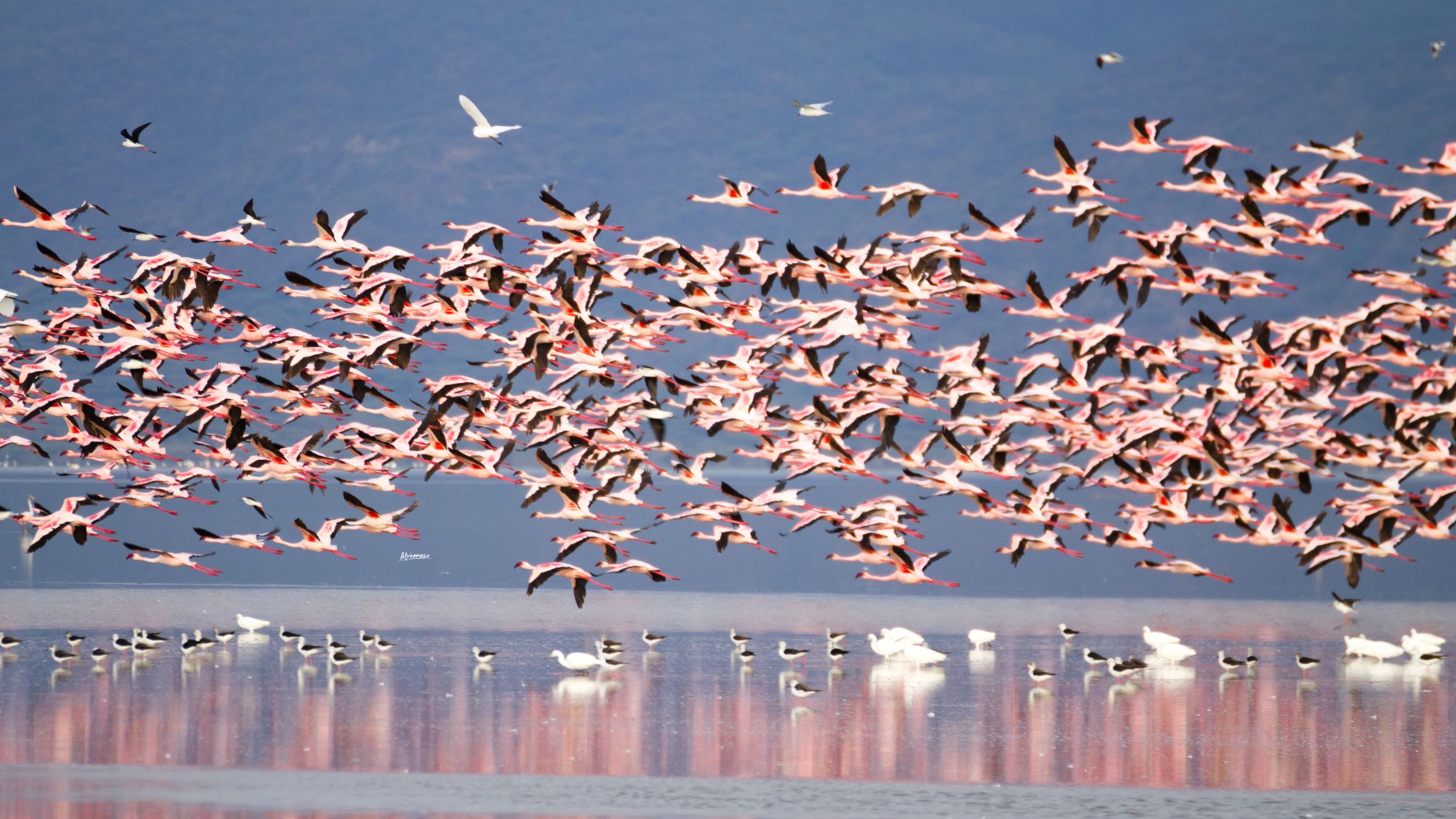
A lake few things can survive
Lake Natron lies in the Rift Valley close to the Kenyan border, north of the Ngorongoro Highlands. It is a shallow soda lake fed by mineral-rich springs and the Ewaso Ng’iro river. Evaporation in the heat concentrates sodium carbonate and other salts until the water becomes strongly alkaline, and surface temperatures in the shallows can become extremely hot.
Very little can live in water like this. Animals that die in the lake can become coated in mineral salts, which is the origin of the calcified birds in widely shared photographs.
Why it turns red
The colour comes from microorganisms that thrive in salty, alkaline water, including salt-loving archaea and cyanobacteria. Their pigments turn parts of the lake red, orange or pink, particularly in the dry season when the water is at its shallowest and saltiest.
The same cyanobacteria are the lesser flamingo’s main food. The pigment they contain is what makes the birds pink.
Why flamingos breed here
Lake Natron is the most important breeding site for lesser flamingos in East Africa. The birds nest on salt islands and mudflats in the middle of the lake. The caustic water keeps predators away from the nests, and the lake produces enough food to feed the chicks.
The nesting colonies themselves are out of reach and are protected. What visitors see are flamingos feeding along the lake edge, often in large numbers, with the volcano behind them.
At a glance
- Location
- northern Tanzania, near the Kenyan border
- Drive from Arusha
- roughly five to six hours
- Best season
- June to November, dry season
- Also here
- Ol Doinyo Lengai, Engare Sero waterfall and footprints
- Stay
- two nights recommended
Around the lake
- Ol Doinyo Lengai. The Maasai “Mountain of God” is an active volcano and the only one known to erupt natrocarbonatite lava, which is black when it erupts and weathers to white. Climbing it is a steep overnight ascent for fit walkers.
- Engare Sero waterfall. A walk up a gorge from the lake to a waterfall and pool, guided by local Maasai.
- The Engare Sero footprints. Hundreds of human footprints preserved in volcanic mud near the lake shore, thousands of years old.
Questions we get asked
Will there be flamingos when I visit?
Flamingo numbers move with water levels and food across the Rift Valley lakes. The dry season is usually best, but numbers vary from year to year.
Can I swim in the lake?
No. The water is strongly alkaline. Swim in the Engare Sero river pools instead.
Can I climb Ol Doinyo Lengai?
Yes, with a local guide. It is a steep night climb of around six hours up, starting around midnight, and should only be attempted if you are fit.
Read next